Capital classes: I wonder why “eat the rich” and guillotine jokes are so popular among millennials?
Also Capitalists:
EAT
THE
RICH
good god
*doxxes my bosses if they ever say i should think along these lines*
“i cancelled my vacation plans i’d rather be at work” do_you_smoke_crack.jpg
Sometimes I am criticized in conversations with co-workers as a “mercenary” because I am militant about not giving anything for free.
Well let me tell you, I wasn’t born that way. I have actually said and done some of the things above. I’ve cancelled vacations. I’ve taken pay cuts to stay somewhere out of misplaced sense of loyalty. I’ve taken a pay cut to give my department the resources I felt it needed to succeed. Do you know what happens to an employer who has an employee like this? They take it for granted. Always. They just start to accept it as the norm.
I’m all done with this shit. I don’t work for free. I don’t give my time away. Fuck you, pay me.
When it comes to prayer, there aren’t a lot of rules. Prayer can be as simple, direct and informal as talking to the gods, off the cuff, in a time of need or just because you feel like it. Prayer can also be something you plan and prepare for, whether by making use of the many existing historical or modern prayers to the gods and reading or memorizing them, or by writing your own modern prayers.
You do not have to write your own prayers–it is not a requirement of worshipping the gods. But if you feel called to do it, it can be a wonderful and meaningful way to connect with deity. And while the act of prayer is not an offering, the work you put into creating it can itself be a gift to the gods.
The idea of writing your own prayers to the gods can be intimidating. You look at the readily available surviving texts, the Homeric Hymns, the Orphic Hymns, and they are so beautiful. If that’s the standard, how can we ever attain it?
But it isn’t the standard. It never was. Not all historical hymns were the Homeric hymns. Not all hymns were high art. (And certainly not all prayers were hymns, although the two terms have a lot of overlap in meaning. I usually use the term “prayer” to refer to my own writings, in part because it feels more like I’m focusing on function.)
The Homeric hymns and similar pieces were often performed at festivals and in competitions. The beauty of these hymns, while not separate from their religious significance, is not solely related to their liturgical function. Many of the hymns actually used in ritual were more to the point–more focused on that function. Few of these works survive, and those that do are of widely varying literary quality. (I personally, as a writer of my own prayers, find this idea quite comforting. :))
The Rhetoric of Prayer
I will admit it, I write a lot of prayers of praise and prayers of thanks. I don’t often pray for something and if I do it’s usually pretty informal. (I suspect that says at least as much about my life as it does about my theology.) But many of the same techniques can be used just as effectively in prayers of supplication.
Reciprocity. Like most Indo-European cultures, the ancient Greeks had a view of relationship that included “a gift for a gift.” This does not mean that you are buying friendship–rather, it emphasizes the give-and-take that is a part of any healthy relationship.
A prayer of supplication might include a reminder of past relationship, which can be either a mention of blessings the god has granted you in the past, or a mention of offerings or other services you have provided the god. It can also mention a gift being given at the same time this prayer is being made. Or it can include a promise of future gifts and services. In all cases, it is a statement of relationship.
Myth. Mythic references can refer in general to the greatness of the god, or can be used to point specifically toward the theme of the prayer. For example, a prayer to Aphrodite to bring love into your life might mention the story of Pygmalion and Galatea as an example of the goddess’ greatness. It goes without saying that these mythic references should be positive ones–you might use stories from the Iliad in a prayer praising Athena, but probably not in one for Ares.
History. Since we lack a large and thriving worship community, for concrete examples I sometimes refer back to the power and prestige a god enjoyed in the distant past. If you are asking Apollo for divinatory help, a mention of his oracular prowess at Delphi would be appropriate; if you are asking his help in health matters, the role he took at ancient healing temples would be more to the point.
Style. Historically, some sorts of prayer were believed particularly appropriate to certain gods. The dignified paean was Apollo’s, while the livelier dithyramb was for Dionysos. For a modern writer, you may want to keep in mind the rhythm of the words and metre when writing.
Voice. While a hymn or prayer of praise may be written in the third person, all the better to tell a good story, a prayer that asks for something is most often written in the second person, thus providing a direct, personal message from the writer/speaker to the god.
The Elements of Prayer
Although there is no precise and standard form that all historic prayers followed, there are a few guidelines, things that a number of prayers tended to have in common. Generally Greek prayers included three parts, each providing a different function.
Invocation. First of all, you need to get the god’s attention, and to get the interaction off on the right foot. Call to the god by name, including words of praise (pro tip, all the gods are beautiful, all the gods are mighty :)) and by the use of descriptive words and phrases. Referring to Asklepios as “son of Apollo” underlines the sort of healing power he comes from. Referring to Apollo as “swift-shooting” has a different meaning than referring to him as “sweet-singing,” although both emphasize his power and skill.
Note that there is nothing wrong with using an epithet you’ve seen in historical texts, “ox-eyed Hera” and “thundering Zeus” were common phrases and had all the more meaning because they were known and understood by all.
Argument. Here you give reasons why the god should look favorably on your request. (See Reciprocityabove.) You can also include reasons based on something other than personal relationship–for example, asking for help in matters of love from Aphrodite, or in matters of justice from Zeus, because those are among their respective realms. This is where you make your case.
Request. Finally you ask the god to look kindly on your request, to grant you their blessings and gifts.
Example: Invocation: Grey-eyed Athena, daughter of thundering Zeus, Argument: if ever I have poured out sweet wine for you, Request: look kindly on me and grant me your wisdom.
The Act of Prayer
It was traditional to stand while praying, with arms raised toward the heavens.
If praying to a chthonic deity, it would be appropriate to kneel (placing yourself symbolically closer to their realm), or to focus your attention toward the earth in some other way.
(It is more than appropriate, by the way, to sing hymns, as was often done historically, if this is something you feel drawn to do. A performance, again, is work that is a gift to the gods.)
“If you are a dreamer, come in. If you are a dreamer, a wisher, a liar, a hoper, a prayer, a magic-bean-buyer. If you’re a pretender, come sit by my fire, for we have some flax-golden tales to spin. Come in! Come in!”
Ἑβδόμη Φθίνοντος/ Ἑβδόμη μετ’εἰκάδας, XXIV day From today’s sunset: twenty-fourth day of Mounychion. Since for today there are no other religious prescriptions, apart from the daily ones, we honor Hermes in His sacred day.
(Hermes attending to a rite in the Delos Island. The God is represented near a woman, named Delos, and seated on an “omphalos”. Made in Athens, 450-400 BC, found in the Spina Necropolis, Ferrara, Archaeological Museum)
Hermes Eriounes, god of messengers, commerce, travel, and the winds, god of the home, luck, language, and memory, guide of the dead: everything I learn about you makes my heart soar. You are Hermeneutes and I will learn words for you: petasos, talaria, rhabdos with which you bring me sleep, kratus Argeiphontes. I will wear your tortoises and save you the best strawberries, I will honor your fourth day of every week and every month, god of boundaries– accepting god both Khthonic and Ouranic– thank you.
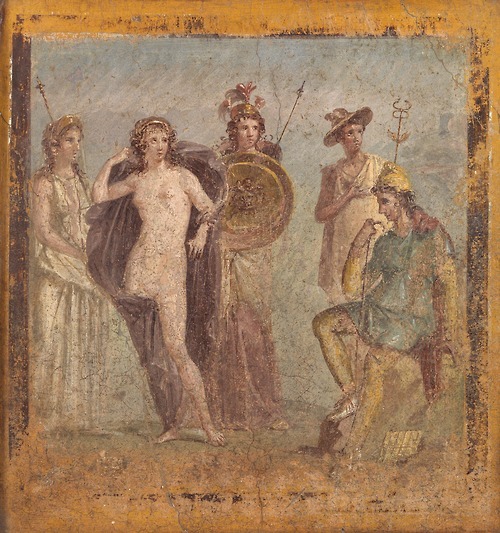





 Hermes